Kitchen Measurement Conversion Chart Every Home Cook Needs
How to finally stop second-guessing yourself mid-recipe and bake with real confidence.
There’s a particular kind of kitchen panic that most of us know well. You’re halfway through a recipe, flour dusted across the counter, and suddenly you’re staring at “2 fluid ounces” wondering whether that’s more or less than a quarter cup. You flip the recipe over. You reach for your phone with floury hands. You Google it, get distracted, lose your place.
It happens to everyone. Even experienced home cooks.
That’s exactly why a good kitchen measurement conversion chart is one of those quiet, unglamorous tools that quietly changes everything. Not dramatic. Not exciting. Just genuinely, deeply useful the kind of thing you hang inside a cabinet door and reach for more often than you’d expect.
Why Cooking Measurements Trip Us Up
The truth is, cooking measurements weren’t designed with simplicity in mind. They evolved across different countries, different eras, and different systems which is why a single recipe might ask for grams in one line and cups in the next.
American recipes tend to lean on volume measurements: cups, tablespoons, teaspoons. Many European and international recipes use weight, which means grams and millilitres. And then there’s the older imperial language pints, quarts, gallons which still shows up in everything from jam-making guides to vintage cookbooks.
The result? Even a confident cook can find themselves pausing over questions like:
- How many tablespoons are in ¼ cup?
- Does 1 pint equal 2 cups or 4?
- What’s the difference between fluid ounces and dry ounces?
These are not silly questions. They’re just gaps that a solid baking conversion chart fills so your attention can stay on the food instead.
Breaking Down the Chart: What Each Section Means
Let’s walk through the key sections so you know exactly what you’re looking at and when to reach for each one.
Liquid Volume: Gallons, Quarts, and Pints
These larger liquid measurements come up most often in preserving, batch cooking, and making broths or soups. Here’s the simple chain to remember:
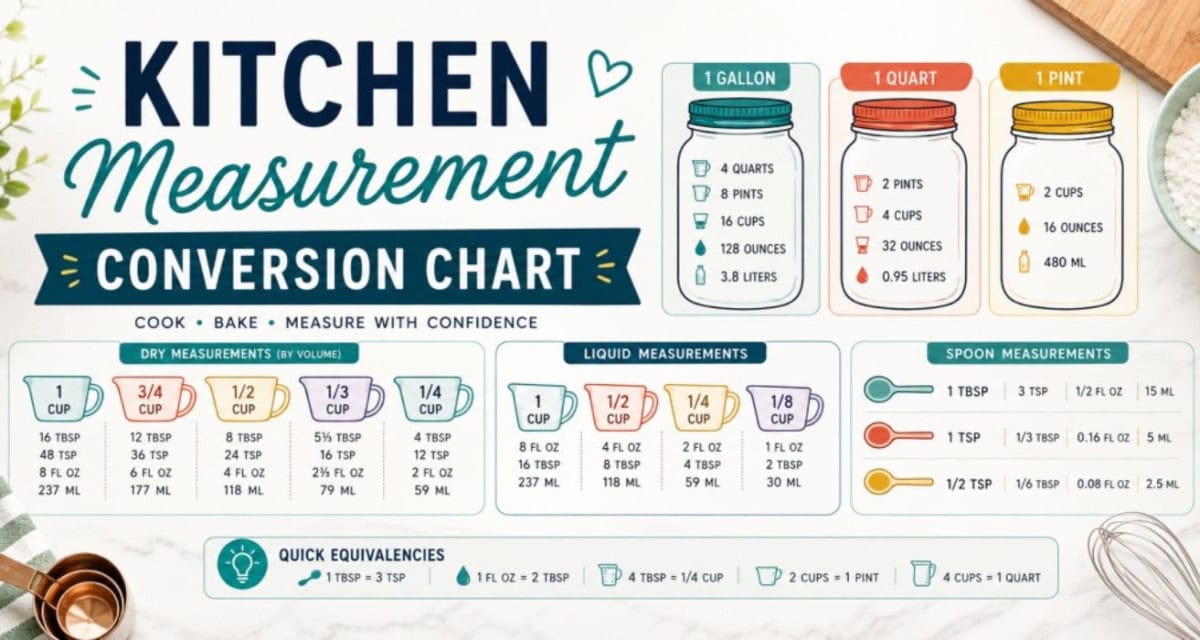
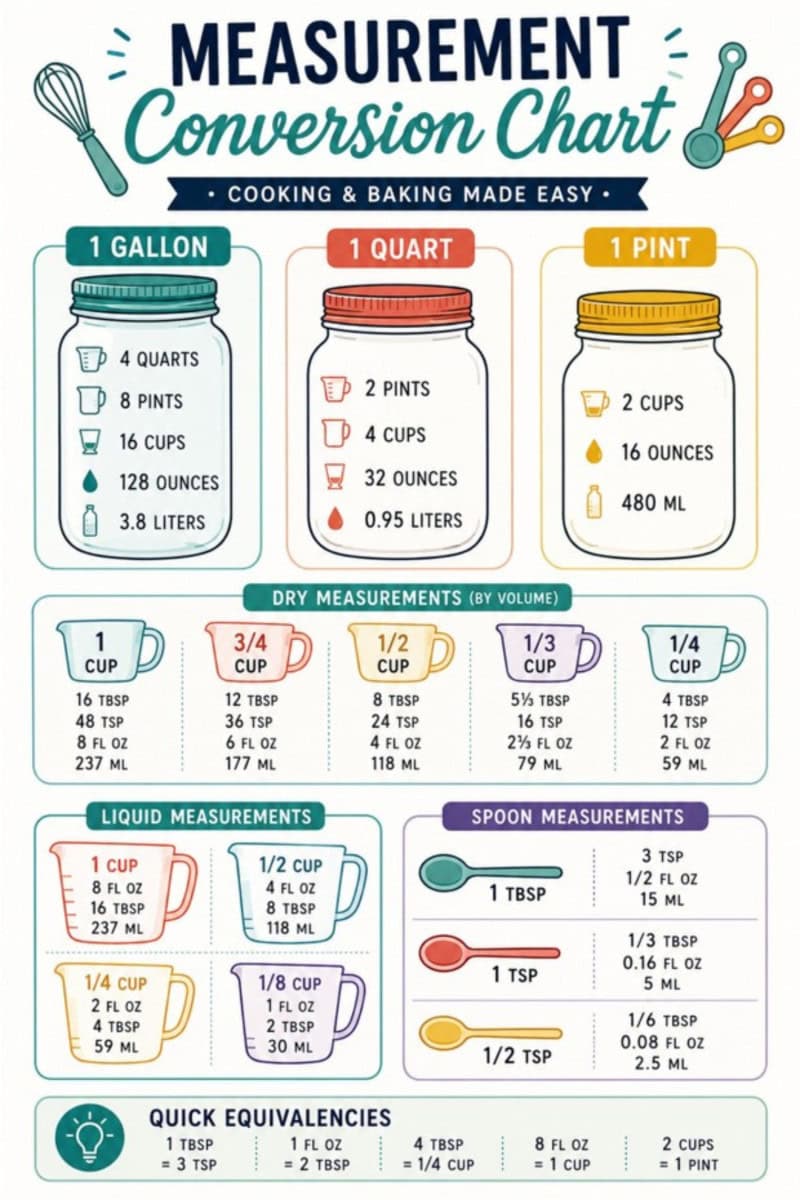
1 gallon = 4 quarts = 8 pints = 16 cups = 128 fl oz = 3.8 litres
Most home cooks won’t measure by the gallon regularly, but if you ever scale up a recipe for a crowd or want to convert a quart of broth into cups, this section is your anchor.
Dry Measurements by Volume
This is where everyday cooking gets interesting. Measuring dry ingredients by volume (rather than weight) is standard in most home recipes but the fractions can get confusing fast.
A full cup breaks down like this:
- 1 cup = 16 tablespoons = 48 teaspoons = 237 ml
- ¾ cup = 12 tablespoons = 36 teaspoons = 177 ml
- ½ cup = 8 tablespoons = 24 teaspoons = 118 ml
- ⅓ cup = 5⅓ tablespoons = 16 teaspoons = 79 ml
- ¼ cup = 4 tablespoons = 12 teaspoons = 59 ml
That ⅓ cup measurement 5⅓ tablespoons is the one that trips people up most often. If you’re cooking with fractional measurements regularly, it’s genuinely worth having this section visible in your kitchen.
Spoon Measurements
Spoon measurements matter more than most people realise, especially in baking where precision can be the difference between a perfectly risen cake and a dense one.
- 1 tablespoon = 3 teaspoons = ½ fl oz = 15 ml
- 1 teaspoon = ⅓ tablespoon = 0.16 fl oz = 5 ml
- ½ teaspoon = ⅙ tablespoon = 2.5 ml
These become especially handy when you’re scaling a recipe up or down. Doubling a recipe that calls for 1½ teaspoons of baking powder? Knowing that equals ½ tablespoon makes the math immediate.
Quick Equivalencies
This is the section worth memorising or at least keeping close. These are the conversions that come up again and again:
- 1 tablespoon = 3 teaspoons
- 1 fl oz = 2 tablespoons
- 4 tablespoons = ¼ cup
- 8 fl oz = 1 cup
- 2 cups = 1 pint
Once these become second nature, the mental overhead of following a recipe drops considerably.
The Case for Metric (Even If You Don’t Use It Yet)
If you grew up measuring in cups and tablespoons, switching to grams can feel unnecessary. But there’s a reason most professional bakers and many home cooks around the world prefer it: weight is simply more accurate than volume for dry ingredients.
A cup of flour, for example, can vary by as much as 20% depending on whether it’s been sifted, spooned, or scooped directly from the bag. A gram is always a gram.
This is why a baking conversion chart that includes metric measurements millilitres alongside cups, grams alongside ounces becomes so valuable if you ever bake from international recipes or want to improve your precision. Even just having the millilitre equivalents on hand means you can use any measuring jug, not just the ones marked in cups.
Hanging It Where It Actually Helps
The thing about a kitchen measurement conversion chart is that it only works if it’s accessible. Not buried in a drawer, not saved somewhere in your phone that takes four taps to find actually there, in the moment you need it.
A few places that work beautifully:
- Inside a cabinet door, right above your measuring cups and spoons
- Laminated and placed in a recipe binder you use regularly
- As a small framed print near the stove it looks intentional and reads as quiet kitchen décor rather than a utility sheet
- Pinned to the inside of your pantry door, especially if that’s where you store your baking staples
Many people print theirs on cardstock and laminate it so it survives the inevitable splashes and flour clouds. Others keep a printable version saved to their phone’s photo roll for quick reference.
A Note on Scaling Recipes
One of the most practical uses of a conversion chart and one that doesn’t get talked about enough is recipe scaling.
Say you have a cookie recipe that makes 48 and you only want 12. You’ll need to divide every measurement by four. Suddenly ½ cup becomes 2 tablespoons, and 1 teaspoon becomes ¼ teaspoon. Having your chart visible turns that kind of mental arithmetic from stressful to straightforward.
The same applies when you’re cooking for a crowd. Scaling up a soup recipe from 4 to 16 servings means converting tablespoons into cups, and cups into pints which is exactly what the liquid measurement section of the chart is designed for.
The Quiet Confidence of Knowing Your Measurements
There’s something genuinely satisfying about reaching the point in your cooking where measurements feel fluent. Where you don’t have to stop and calculate you just know that 4 tablespoons is a quarter cup, or that a pint and 2 cups are the same thing.
That fluency doesn’t come from memorisation alone. It comes from having good references close by, using them consistently, and letting the knowledge settle in naturally over time.
A simple, well-designed kitchen measurement conversion chart is one of the most humble tools you can keep in your kitchen. It asks for almost nothing a small piece of wall space, a cabinet door, a corner of the counter and in return, it quietly removes one of the most common sources of cooking frustration.
Not every kitchen upgrade needs to be expensive or elaborate. Sometimes the most useful thing is just a well-organised chart, right where you need it, every single time.

Michelle
Hi, I’m Michelle, the founder, owner, author, and editor of OvenSpot. My passion for one-pot cooking commenced when I was working to prepare cafeteria lunches for school students. I am now on a mission to assist you in choosing the cooking pot or appliance you will use daily. As well as in-depth information to assist you in using and caring for your cookware and appliances. Along with the yummy recipes I use at home.
Questions? Reach out to Michelle at [email protected]